You Won’t Believe What I Found at Boudhanath—This Place Is Alive
I never expected a single site to hold so much energy—until I stood beneath the all-seeing eyes of Boudhanath Stupa in Nepal. This isn’t just a monument; it’s a living, breathing world where prayer wheels spin with purpose and monks chant like the city’s quiet heartbeat. More than a pilgrimage point, it’s a portal into something deeper. What makes this place vibrate with such peace? Let me take you through the layers that make Boudhanath not just a stop, but a soul shift. It is one of the most powerful spiritual centers in the world, not because of spectacle, but because of presence. Here, devotion is not performed—it is lived, moment by moment, breath by breath, step by step.
The First Glimpse: Arriving at a Spiritual Epicenter
Stepping into Boudhanath feels like crossing a threshold into another dimension. The chaotic hum of Kathmandu—honking scooters, street vendors, and dust-choked air—fades as the massive whitewashed dome of the stupa rises ahead, crowned by the serene, watchful eyes of the Buddha. This sudden shift in atmosphere is not imagined; it is deeply felt. Visitors often pause, catching their breath, not from exertion but from awe. The stupa stands like a beacon, calm and unshaken amid the city’s turbulence, drawing people inward with quiet authority.
Boudhanath is more than a religious site; it is a spiritual epicenter for Tibetan Buddhists in Nepal and around the world. As one of the largest stupas in Nepal and a designated UNESCO World Heritage Site, it holds both cultural and historical significance. Its importance dates back centuries, believed to have been originally constructed in the 14th century, though some traditions trace its roots even further. What sets it apart from other sacred spaces in the Kathmandu Valley is its scale, symmetry, and the continuous flow of life that surrounds it. Unlike temples that open and close, Boudhanath is alive at all hours—especially at dawn and dusk, when the circumambulation path, known as the kora, begins to fill with devotees.
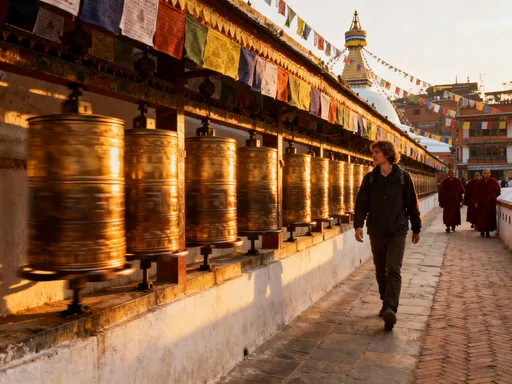
The kora is the first invitation into the rhythm of Boudhanath. As soon as visitors step onto the wide stone path that circles the stupa, they are drawn into its meditative cadence. Pilgrims walk slowly, clockwise, murmuring mantras, spinning prayer wheels, or counting beads on mala strings. There is no rush, no competition—only movement with intention. This circular path, embedded with meaning, becomes a physical manifestation of spiritual progress. Even first-time visitors, unaware of the rituals, often find themselves adjusting their pace, lowering their voices, and walking with a newfound reverence. The atmosphere teaches before any explanation is needed.
The Stupa Itself: Architecture as Meditation
The Boudhanath Stupa is not merely a structure—it is a three-dimensional mandala, a sacred geometry designed to guide the mind toward enlightenment. Every element of its design carries symbolic weight, transforming the entire monument into a silent teaching. The massive dome represents the earth, while the square harmika above it, painted with the all-seeing eyes of the Buddha, symbolizes the sky and the awakened mind. These eyes, painted on all four sides, do not just look out—they see inward, reminding all who pass that awareness is constant and all-encompassing.
Above the harmika rises the 13-tiered spire, each level representing a stage on the path to Nirvana. This spire, once gilded and shimmering in the sun, is both a crown and a ladder—pointing upward, yet firmly rooted in the earth. The entire structure is crowned with a golden canopy and a gilded pinnacle, traditionally said to contain relics of the Buddha, making the stupa not just a representation of enlightenment but a vessel of its presence. The mandala design, visible from above, reinforces the idea of cosmic order and spiritual harmony, drawing the observer into a sense of balance and unity.
The resilience of Boudhanath was tested in 2015, when a powerful earthquake struck Nepal, damaging many historic sites. The stupa sustained significant cracks in its dome and spire, yet it did not collapse. In the months that followed, a massive restoration effort began, led by local artisans, monks, and heritage experts. What was remarkable was not just the technical precision of the reconstruction, but the communal spirit behind it. Donations came from Tibetan communities worldwide, and every brick was laid with prayer and intention. By 2016, the stupa was restored, not as a replica, but as a renewed symbol of cultural endurance. Its survival and rebirth deepened its spiritual significance, proving that faith and tradition can withstand even the most violent disruptions.
The Five Theme Zones: Mapping the Soul of Boudhanath
To fully understand Boudhanath is to recognize that it is not just a single monument, but a living ecosystem of devotion, community, and daily life. The area around the stupa can be thought of in five distinct yet interconnected theme zones: the Sacred Core, the Prayer Belt, the Monastic Quarter, the Pilgrim Market, and the Rooftop Cafés. Each zone offers a different way to engage, allowing visitors to move from outer observation to inner reflection.
The Sacred Core is, of course, the stupa itself and the immediate kora path. This is where the most intense spiritual energy is felt. Devotees walk with bowed heads or prostrate themselves fully, covering the entire circuit in acts of deep reverence. It is here that the sound of chanting is most concentrated, blending with the soft clinking of prayer wheels and the rustle of prayer flags fluttering in the wind. The atmosphere is solemn, yet welcoming—locals often smile at newcomers, encouraging them to join, even if only for a single lap.
Surrounding the stupa is the Prayer Belt—a ring of small shrines, butter lamps, and hundreds of prayer wheels embedded in wooden frames. This zone transforms devotion into tactile ritual. Pilgrims spin the wheels with focused intention, believing that each rotation sends the contained mantras into the universe. Lighting a butter lamp, often accompanied by a silent prayer, is another common practice. The glow of these lamps, especially at dusk, creates a warm, flickering halo around the stupa, symbolizing the light of wisdom dispelling ignorance.
Beyond this lies the Monastic Quarter, where Tibetan Buddhist monasteries line the narrow streets. Red-robed monks can be seen carrying books, sweeping courtyards, or engaging in philosophical debates in open-air study halls. The presence of these monasteries ensures that Boudhanath is not just a place of worship, but of learning and discipline. Some monasteries offer meditation sessions or short teachings for visitors, making ancient wisdom accessible to those who seek it.
The Pilgrim Market is the commercial heart of the area, yet it remains deeply connected to spiritual life. Stalls sell mala beads, incense, thangka paintings, and ritual items, all used in daily practice. The market also offers simple food—steaming bowls of tsampa porridge, butter tea, and momos—catering to pilgrims and travelers alike. Prices are modest, and bargaining is gentle, reflecting the area’s ethos of simplicity and generosity.
Finally, the Rooftop Cafés provide a space for pause and perspective. Located in guesthouses and small hotels, these cafés offer panoramic views of the stupa and its swirling activity. Sipping a cup of milk tea while watching the kora below becomes a form of contemplation in itself. This vantage point allows visitors to step back, reflect, and integrate their experience before returning to the world beyond.
The Sacred Core: Walking the Kora with Purpose
Walking the kora is the central act of engagement at Boudhanath. To walk this path is not to sightsee, but to participate. Devotees move clockwise, following the sun’s path, in alignment with Tibetan Buddhist tradition. Each step is an offering, a way to accumulate merit and purify negative karma. Many carry mala beads, reciting the mantra Om Mani Padme Hum—the chant of compassion—over and over, letting the rhythm of the words sync with their footsteps.
The spiritual logic behind the kora is profound. It is not a race, nor a performance, but a practice of mindfulness in motion. The circular path mirrors the cycle of samsara—the endless cycle of birth and rebirth—while the act of walking with intention represents the journey toward liberation. Even for non-Buddhists, the experience can be deeply meditative. The repetition, the quiet focus, the shared silence among strangers create a rare sense of unity and presence.
For visitors, the best times to walk the kora are early morning and late afternoon. At dawn, the air is cool, the light soft, and the path is filled with local devotees beginning their day with prayer. At dusk, the butter lamps are lit, and the chanting grows louder as monks gather for evening prayers. To walk respectfully, visitors should keep to the left, follow the clockwise direction, and avoid stepping on the thresholds of shrines. It is also customary to remove hats and refrain from loud conversations. Cameras are allowed, but photos of people in prayer should be taken discreetly and only with permission. Most importantly, the kora is not about completing laps—it is about being present with each step.
The Prayer Belt: Where Devotion Spins Constantly
The ring of prayer wheels that encircles Boudhanath is one of its most captivating features. Hundreds of brass and wooden wheels, each inscribed with the Om Mani Padme Hum mantra, are set into wooden frames along the outer edge of the kora. Pilgrims walk slowly, spinning each wheel with their right hand, believing that each rotation releases the mantra into the world, spreading compassion and blessings.
This tactile form of prayer makes devotion immediate and accessible. Unlike silent meditation, which can feel abstract, spinning a prayer wheel is a physical act of faith. The wheels vary in size—some small enough to turn with a fingertip, others requiring both hands. Over time, the constant spinning has worn grooves into the wooden frames, a testament to the countless hands that have passed through. The sound is subtle but constant—the soft thud of brass against wood, the occasional metallic ring—adding to the site’s rich soundscape.
Adjacent to the prayer wheels are rows of butter lamps, small brass bowls filled with oil and a floating wick. Lighting a lamp is an act of offering, symbolizing the illumination of wisdom. Devotees often light lamps for loved ones, for healing, or for the peace of the world. The flickering flames, especially in the dim light of evening, create a mesmerizing glow, turning the base of the stupa into a sea of light. The scent of burning butter and incense fills the air, grounding the experience in the physical senses. This sensory richness—sound, touch, smell, sight—makes Boudhanath not just a place to see, but a place to feel.
Beyond the Stupa: The Living Community Around It
Boudhanath is not a museum piece preserved behind glass—it is a living community sustained by faith, tradition, and daily practice. The Monastic Quarter, just beyond the main complex, is home to numerous Tibetan Buddhist monasteries that have been rebuilt and reestablished since the 1959 Tibetan diaspora. These monasteries are not silent retreats; they are centers of vibrant intellectual and spiritual life. Monks study ancient texts, practice ritual music, and engage in philosophical debates that echo through open courtyards.
Visitors are often surprised by the warmth and openness of the monastic community. While some areas are restricted, many monasteries welcome guests for short visits or meditation sessions. Some even offer beginner-friendly teachings on mindfulness and compassion. The presence of young monks, some as young as ten, reminds visitors that this tradition is being passed down, not preserved in isolation, but lived and renewed with each generation.
The Pilgrim Market, though commercial, remains deeply rooted in spiritual culture. Vendors sell items used in daily practice—incense for purification, mala beads for counting mantras, thangka paintings that depict Buddhist deities and mandalas. These are not souvenirs in the tourist sense, but sacred objects with purpose. The market also serves as a social hub, where pilgrims from remote villages meet, share stories, and rest before continuing their journey. Food stalls offer simple, nourishing meals—steaming bowls of tsampa, the roasted barley flour that is a staple of Tibetan diet, and thick, salty butter tea that warms the body in Kathmandu’s cool mornings.
Throughout the area, meditation centers and guesthouses offer drop-in sessions for travelers seeking quiet reflection. These spaces are not elaborate; they are often simple rooms with cushions and a few statues. But in their simplicity lies their power. Sitting in silence, surrounded by the distant sound of chanting, one begins to understand that peace is not found in escape, but in presence. The community around Boudhanath does not exist to serve tourists—it exists to live its faith. And in doing so, it invites others to pause, listen, and perhaps, feel a shift within.
Rooftop Reflections: Seeing Boudhanath from Above
After hours of walking, chanting, and absorbing the energy of the stupa, stepping onto a rooftop café offers a different kind of revelation. From above, Boudhanath reveals its patterns—the circular flow of the kora, the clusters of butter lamps, the red-robed monks moving like brushstrokes across a canvas. The chaos of ground-level immersion gives way to a sense of order, rhythm, and harmony. It is here, with a cup of tea in hand, that the mind begins to integrate what the heart has felt.
The rooftop vantage point does not diminish the sacredness of the site; it deepens it. Seeing the stupa in its entirety—its symmetry, its scale, its relationship to the surrounding buildings—adds a layer of understanding that is difficult to grasp from within. The all-seeing eyes, now visible from a distance, seem to watch not just the immediate path, but the wider world. The fluttering prayer flags, strung between buildings, carry mantras on the wind, spreading blessings far beyond the compound.
These cafés are quiet spaces, designed for reflection rather than socializing. Travelers sit alone or in small groups, often in silence, gazing down at the swirling movement below. Some journal, others meditate, and many simply breathe, letting the experience settle. This moment of pause is essential—it completes the emotional arc of the visit, moving from engagement to integration. It is not escape, but perspective. And in that perspective, a deeper truth emerges: that Boudhanath is not just a place to visit, but a state of being to carry forward.
Conclusion: Why Boudhanath Stays With You
Boudhanath remains with you long after you leave because it does not merely display culture—it allows you to feel it. The combination of sacred architecture, living ritual, and a resilient community creates a resonance that lingers in the soul. It is not the size of the stupa, nor the fame of the site, that makes it powerful. It is the quiet certainty of devotion, the rhythm of prayer, and the warmth of a community that has preserved its identity through decades of change.
This place teaches without words. It shows that peace is not the absence of noise, but the presence of purpose. It reveals that spirituality is not confined to temples, but lives in the way people walk, speak, and care for one another. Boudhanath is not a destination to check off a list; it is an experience to be entered, slowly and with openness. It invites not just sightseeing, but soul-seeing.
For those who visit with an open heart, Boudhanath offers more than memories—it offers a shift. A shift in how one sees the world, how one moves through life, how one understands connection. It reminds us that some places are not just seen, but felt. And in that feeling, we find not just culture, but compassion. Not just history, but hope. If you go, walk slowly. Listen deeply. And let the all-seeing eyes remind you that you, too, are seen—and that in being seen, you are part of something greater.