Lost in the Pulse of Kuala Lumpur
Ever felt a city grab you and refuse to let go? That’s Kuala Lumpur. Wandering its streets, I stumbled upon views that stole my breath—skylines piercing clouds, hidden alley art, quiet temple corners above the noise. This isn’t just sightseeing; it’s feeling the city breathe. From golden sunsets over the Petronas Towers to steam rising from a midnight street noodle stall, KL reveals itself slowly, honestly. You don’t chase the view—you let it find you. In a world where travel often means ticking off landmarks, Kuala Lumpur teaches a different rhythm: one of pause, presence, and discovery through wandering. It’s a city that rewards those who look beyond the obvious and embrace the quiet moments between the noise.
First Glimpse: Arrival and First Impressions
Landing at Kuala Lumpur International Airport, or KLIA, is like stepping into a new climate—and a new pace of life. The doors open, and a wave of warm, humid air wraps around you, carrying the faint scent of tropical foliage and distant rain. The terminal itself reflects Malaysia’s modern ambitions: sleek lines, polished floors, and a quiet efficiency that sets the tone for the journey ahead. This is not just a transit point but a threshold into a city where tradition and innovation coexist with surprising ease.
Getting into the city center from KLIA is straightforward, with several reliable options catering to different needs and budgets. The KLIA Express train is often the top choice for travelers seeking speed and comfort. In just 28 minutes, it glides nonstop to KL Sentral, the city’s main transport hub, with spacious seating, luggage racks, and large windows offering a preview of the urban landscape unfolding outside. A one-way ticket costs around 55 Malaysian ringgit, a reasonable price for the time saved and the smooth ride.
For those with more luggage or traveling in groups, ride-hailing apps like Grab offer door-to-door convenience. Fares to the city center range from 80 to 120 ringgit depending on destination and traffic, but the ability to relax in air-conditioned comfort while your driver navigates the route is a welcome relief after a long flight. Taxis are also available, though it’s wise to use the official booths and ensure the meter is running to avoid overcharging. Each option has its merits, but all lead to the same moment: your first real view of Kuala Lumpur.
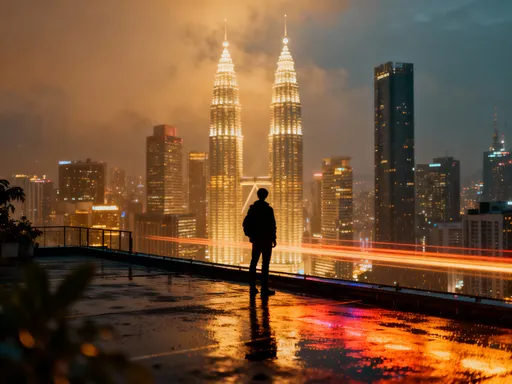
That moment often comes at dusk, when the city begins to awaken in light. As you approach the central districts, the skyline emerges—a jagged line of steel and glass crowned by the unmistakable silhouette of the Petronas Twin Towers. Lit from within and outlined in shimmering white, they rise like twin sentinels above the urban sprawl. Other towers—Menara TM, The Exchange 106, and the sleek KL Tower—add to the skyline’s rhythm, each contributing to a cityscape that feels both futuristic and grounded in its tropical setting. The emotional impact is immediate: a mix of awe, curiosity, and the quiet thrill of beginning an adventure with no fixed plan.
This is the essence of arriving in Kuala Lumpur—not with a checklist, but with openness. There’s no need to rush. The city doesn’t reveal itself all at once. Instead, it unfolds gradually, inviting you to slow down, observe, and let the details sink in. Whether you’re staying in a luxury hotel near Bukit Bintang or a modest guesthouse in Chinatown, the city’s pulse is already within reach. The journey has just begun, and the first glimpse is only the overture to what’s ahead.
Sky-High Perspectives: The Iconic Viewpoints
To truly understand Kuala Lumpur, you must see it from above. The city’s verticality is one of its defining characteristics, and few experiences compare to standing hundreds of meters above ground, watching the urban fabric stretch in every direction. The most famous vantage point is, without doubt, the observation deck of the Petronas Twin Towers. Once the tallest buildings in the world, these 88-story towers remain the heart of KL’s skyline and a symbol of Malaysia’s modern identity.
Access to the Skybridge and observation deck on the 37th and 38th floors requires advance booking, as tickets sell out quickly. Priced at around 80 ringgit for adults, the experience includes a short multimedia presentation on the towers’ construction and a timed entry to manage crowds. The best time to visit is late afternoon, just before sunset. As daylight fades, the city transitions from warm gold to deep blue, and the towers themselves begin to glow with internal lighting. From this height, you can trace the grid of major roads, spot distant parks, and see how neighborhoods blend into one another like pieces of a living puzzle.
The glass walls of the observation deck offer unobstructed views, but they also create a sense of safety that contrasts with the sheer drop just beyond. There’s something humbling about standing so high yet feeling so contained. The towers’ design, inspired by Islamic geometric patterns, adds a cultural layer to the experience—this is not just an engineering marvel but a structure rooted in local identity.
Another powerful perspective comes from the KL Tower, perched on Bukit Nanas, a small forested hill in the city center. Unlike the Petronas Towers, which emphasize sleek modernity, the KL Tower blends technology with nature. Its needle-like spire supports telecommunications equipment, but the base houses a public observation deck and a revolving restaurant called Atmosphere 360. Dining here is an experience in motion—every 60 minutes, the floor completes a full rotation, offering a slow, panoramic reveal of the city.
The outdoor deck, open to all visitors, provides a more immediate and unfiltered view. On clear days, you can see as far as the Strait of Malacca to the west and the Titiwangsa Mountains to the east. The surrounding greenery of the Bukit Nanas Forest Reserve frames the skyline, reminding you that even in a bustling metropolis, nature is never far away. The air feels cooler here, fresher, carrying the scent of damp earth and leaves.
What sets these high viewpoints apart is not just their elevation but their ability to shift your understanding of the city. From the ground, Kuala Lumpur can feel chaotic—streets packed with vehicles, pedestrians weaving through crowds, sounds overlapping in a constant hum. But from above, order emerges. You see how the LRT and monorail lines connect distant neighborhoods, how parks serve as green lungs, and how waterways cut through the urban grain. Elevation doesn’t just offer a better view; it offers clarity. It transforms the city from a collection of places into a coherent whole.
Street-Level Magic: Wandering Through Contrasts
While the sky-high views offer clarity, it’s at street level that Kuala Lumpur reveals its soul. This is where the city breathes, where its rhythms are felt in the pulse of footsteps, the sizzle of street food, and the murmur of conversations in half a dozen languages. Walking through districts like Bukit Bintang and Chinatown is not just about seeing sights—it’s about immersion.
Bukit Bintang, the city’s entertainment and shopping heart, dazzles with neon signs, glass-fronted malls, and the constant movement of people. Pavements widen into pedestrian zones, where pop-up stalls sell everything from phone cases to handmade jewelry. The air hums with energy, amplified by music spilling from cafes and the occasional street performer. Yet, even in this commercial hub, moments of stillness appear unexpectedly—a small mosque tucked between two shopping complexes, its courtyard shaded by palm trees, where worshippers pause in quiet reflection.
These contrasts define Kuala Lumpur. In Petaling Street, the heart of Chinatown, the market buzzes with activity from early morning until well past midnight. Vendors sell knockoff bags, spices, and traditional Chinese medicine, while food carts offer steaming bowls of char kway teow and dim sum baskets carried on bamboo steamers. The scent of soy sauce, chili, and roasted meat fills the air. Above the stalls, laundry hangs from upper-floor windows, and faded signs in Chinese calligraphy hint at decades of history.
But venture down a side alley, and the scene shifts. A narrow staircase might lead to a rooftop bar with a raw, unfiltered view of the skyline. Or you might stumble upon a quiet temple, its entrance marked by red lanterns and incense coils burning slowly in the breeze. These are the moments that maps can’t capture—discoveries made only by wandering without a fixed route.
Walking teaches you to notice the small things: the way sunlight filters through a canopy of trees in a hidden courtyard, the sound of a hawker calling out his specials in Malay and Cantonese, the texture of old shophouse walls weathered by time and rain. These details form a narrative more intimate than any guidebook. They remind you that a city is not just a collection of landmarks but a living, evolving organism shaped by the people who inhabit it.
Hidden Heights: Off-the-Beaten-Path Vantage Spots
For those willing to look beyond the postcard views, Kuala Lumpur offers quieter, more personal perspectives. These are not the crowded observation decks but hidden spots where the city reveals itself in unexpected ways. One such place is Heli Lounge Bar, perched on the 33rd floor of a commercial building near the old airport helipad. Once a functional helipad, it has been transformed into a rooftop bar with no cover charge and a 360-degree panorama of the city.
Sunset is the ideal time to visit. As the sky turns orange and pink, the city lights begin to flicker on, one by one. There’s no formal seating—just high tables and standing room—but the atmosphere is relaxed, frequented by locals and in-the-know travelers. The lack of glass barriers means you feel the breeze, hear the distant hum of traffic, and experience the view as something immediate, not mediated. It’s a rare blend of accessibility and authenticity.
Another hidden gem is Thean Hou Temple, one of the largest Chinese temples in Southeast Asia. Built on elevated ground, it offers sweeping views of the southern part of the city and, on clear days, the coastline. The temple itself is a masterpiece of traditional design, with ornate roofs, colorful mosaics, and statues of deities surrounded by incense smoke. But it’s also a place of calm, where visitors sit on stone benches, meditate, or simply watch the city below. The contrast between spiritual serenity and urban energy is striking.
Green spaces also provide elevated views. Ampang Park, though no longer a park in the traditional sense due to redevelopment, once offered a gentle slope with skyline views and remains a symbolic reminder of the city’s green spaces. More enduring is the Bukit Nanas Forest Reserve, a 131-year-old tropical rainforest in the heart of the city. A short canopy walkway leads to viewpoints where the jungle meets the skyline—a powerful image of nature and city coexisting.
These off-the-beaten-path spots share a common quality: they are not designed for mass tourism. They don’t appear on every itinerary, and that’s what makes them special. They offer authenticity not through isolation, but through integration—with local life, with history, with the natural environment. To find them is to engage with Kuala Lumpur on its own terms, not as a checklist of attractions but as a layered, evolving reality.
Night Visions: How Kuala Lumpur Transforms After Dark
As daylight fades, Kuala Lumpur undergoes a transformation. The heat eases, the sky deepens, and the city begins to glow. This is when KL’s true character emerges—not in the brightness of noon, but in the warmth of artificial light and the rhythm of nocturnal life. Night markets come alive, food stalls fire up their grills, and families, workers, and travelers take to the streets in search of connection and comfort.
Jalan Alor, perhaps the most famous food street in the city, becomes a sensory feast after dark. Strings of red and yellow lanterns hang overhead, casting a golden glow on crowds gathered around small tables. The air is thick with the smell of grilled satay, sambal, and sweet corn. Hawkers move quickly, balancing plates and drinks, calling out specials in rapid-fire Malay. It’s chaotic, yes, but also deeply human—a place where joy is found in simple pleasures.
Brickfields, Kuala Lumpur’s Little India, hosts its own night market, where spice vendors display mounds of turmeric and cumin, and sweet shops offer fresh jalebi and rose-flavored lassi. The sound of Tamil music drifts from open storefronts, and the scent of incense blends with the aroma of curry leaves frying in oil. Here, the city feels intimate, even in its brightness.
For those seeking a quieter perspective, elevated walkways and LRT stations offer unexpected views. From the footbridge connecting KL Sentral to the Mid Valley shopping complex, you can watch light trails form as vehicles move along the Federal Highway. On the monorail, as it glides above the city streets, you see neighborhoods lit from within—apartment windows glowing, rooftop gardens illuminated, street vendors packing up for the night. These moving vantage points offer a cinematic view of the city’s rhythm.
The emotional contrast between day and night is profound. By day, Kuala Lumpur feels ambitious, fast-paced, and forward-looking. By night, it feels more grounded, more connected to the lives of its people. The brightness doesn’t mask the humanity—it reveals it. And in those moments, you realize that the most memorable views are not the ones you plan, but the ones you stumble upon when the city is simply being itself.
Cultural Layers in the Landscape: Seeing Beyond the Surface
To walk through Kuala Lumpur is to move through layers of history, faith, and identity. The city’s architecture tells a story of convergence—colonial buildings with arched windows stand beside mosques with golden domes, while rows of Chinese shophouses line narrow streets with their distinctive five-foot ways. Multilingual signs—Malay, English, Chinese, Tamil—reflect a society where multiple cultures coexist in daily life.
Street art adds another layer. In neighborhoods like Bangsar and Taman Connaught, murals depict everything from traditional folklore to contemporary social themes. These are not just decorations but expressions of identity, often created by local artists who use public space to tell stories that might otherwise go unnoticed.
Observing daily rituals offers further insight. In the morning, Muslim prayers echo from mosques; by midday, Hindu families visit temples with offerings of flowers and fruit; in the evening, Chinese elders gather in parks for tai chi or mahjong. These practices unfold in public view, not hidden away, reminding visitors that diversity here is not a slogan but a lived reality.
Sitting in a hawker center, you see this coexistence in action. A Malay family shares a table with Indian colleagues, while a Chinese couple queues for nasi lemak. The food itself is a fusion—Malaysian cuisine blends Malay, Chinese, and Indian influences into dishes like laksa, roti canai, and Hainanese chicken rice. To eat here is to participate in the culture, not just observe it.
Viewing Kuala Lumpur as a cultural landscape means looking beyond the skyline. It means noticing how people move through space, how they interact, and how traditions are preserved even in a rapidly modernizing city. It’s in these details that the city’s true depth is found.
Wanderer’s Wisdom: Practical Tips for Deeper Viewing
To experience Kuala Lumpur fully, a few practical considerations can make a big difference. Timing is key. Early morning offers soft light and fewer crowds, ideal for photographing landmarks or walking through parks. Golden hour—just before sunset—transforms the skyline into a silhouette of fire and shadow, perfect for capturing the city’s mood. Midnight, though less common, reveals a different KL: quieter, cooler, with a clarity that daytime humidity often obscures.
Transportation is another advantage. The LRT and monorail networks are efficient and affordable, with many stations offering elevated views. KL Sentral, Masjid Jamek, and Bukit Bintang stations are particularly scenic. Using these lines not only saves time but also provides moving perspectives of the city’s layout.
Safety and comfort matter, especially for travelers unfamiliar with tropical climates. Stay hydrated, carry a small umbrella for sudden rain, and wear breathable clothing. In crowded areas like markets and transit hubs, keep valuables secure and be mindful of your surroundings. When visiting religious sites, dress modestly—cover shoulders and knees—and remove shoes when required.
Finally, travel light. A small bag with water, sunscreen, and a phone is all you need. Let go of rigid itineraries. Some of the best moments in Kuala Lumpur happen when you take a wrong turn, follow a scent of food, or accept an invitation from a friendly local. The city rewards curiosity, not control.
The City That Reveals Itself Slowly
Kuala Lumpur does not give up its secrets easily. It is not a city to be conquered in a weekend or captured in a single photograph. Instead, it reveals itself in fragments—in the curve of a temple roof, the steam from a noodle bowl, the laughter of children in a park, the silent glow of towers at midnight. These moments, strung together, form a deeper understanding: that a city is not just a place, but a feeling.
The most lasting views are often the unplanned ones—the alleyway mural you almost missed, the rooftop breeze after a long walk, the kindness of a stranger offering directions. These are the memories that linger, not because they were perfect, but because they were real.
To truly see Kuala Lumpur is to slow down, to look closely, and to allow yourself to be present. Put down the checklist. Step off the main street. Let the city speak. In its pulse, its contrasts, its quiet corners, you’ll find not just a destination, but a connection—one that stays with you long after you’ve left.